When you buy a home in Pune, you’ll go through three important phases.
(1) deciding what to buy — your purpose, budget, location, and configuration;
(2) verifying and negotiating — checking the developer’s RERA status, the property’s legal title, and agreeing on price and payment terms
(3) completing the legal transaction — paying stamp duty (6–7% of property value), registering the sale deed, and completing post-purchase formalities like mutation.
The full process typically takes 4–8 weeks for a ready-to-move property once a buyer has finalized their choice, longer if a home loan is involved.
Why Pune, and Why Now? A Quick Market Context
Before getting into the steps, it helps to know what kind of market you’re buying into. Pune’s residential real estate in 2026 is widely described as being in a “consolidation phase” a mature, steady market rather than a speculative boom. A few data points worth knowing:
- The city’s average flat price has crossed roughly ₹12,950 per sq. ft., though this varies significantly by micro-market.
- Buyer demand is shifting toward higher-value homes: properties priced ₹50 lakh–1 crore now make up close to 29% of registrations, and the ₹1–2.5 crore bracket has grown to around 14% a sign that end-users, not speculators, are driving the market.
- Residential rental yields run 3–5% typically, reaching 5.5–6% in some high-demand pockets.
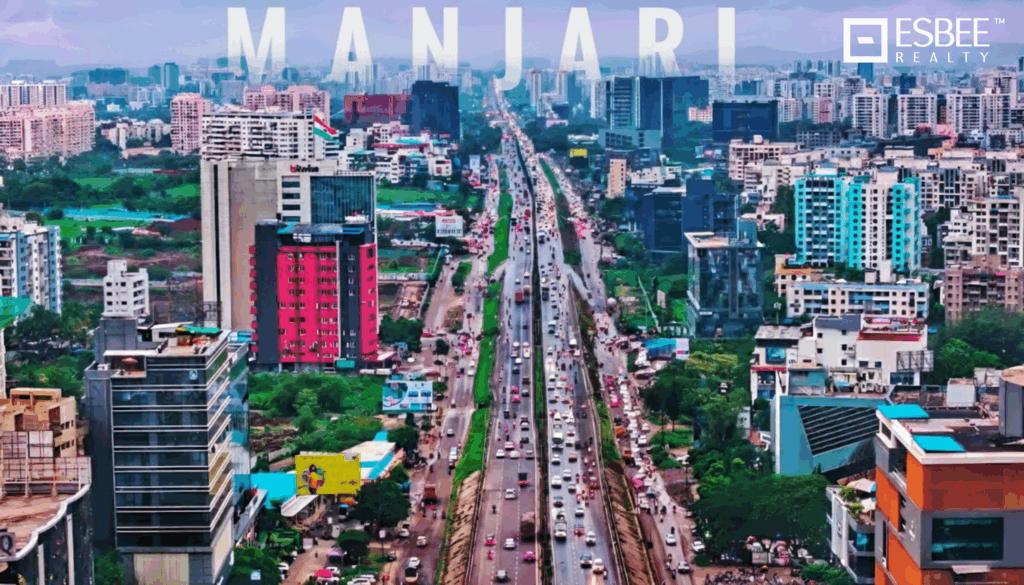
- Growth corridors to watch: flats in Manjari, Hadapsar Kharadi, Viman Nagar, Kalyani Nagar (east, IT-driven); Baner, Bavdhan, Kothrud, Hinjewadi (west, premium + IT); and Punawale, Ravet, Chikhali, Moshi (north, affordable growth belt) largely because of Metro expansion, the Ring Road, and the new Pune airport still being priced into these areas.
For most end-users, market timing matters far less than picking the right locality and developer the fundamentals across Pune are described as broadly stable heading through 2026.
Phase 1: Decide What You’re Actually Buying
Step 1: Clarify Why You’re Buying
If you’re planning to buy a home in Pune, every home purchase starts with a clear “why” that shapes every decision afterward. Are you buying to:
- Live in it yourself (self-use)
- Rent it out for income
- Invest for long-term appreciation
- Accommodate a growing family
- Plan for retirement
A retirement home in a quiet, low-density suburb looks nothing like an investment flat near an IT park — get this clear first.
Step 2: Set a Realistic, Complete Budget
Your budget isn’t just the property price. Account for:
- Down payment (typically 20% of property value)
- Monthly EMI, sized against your actual take-home income, not just loan eligibility
- Stamp duty and registration charges (6–7% + up to ₹30,000 – see the table below)
- Society maintenance and deposit
- Interior/moving costs
- An emergency buffer, so the purchase doesn’t leave you financially stretched
Getting a home loan pre-approval (in-principle sanction) from 2–3 lenders before you start house-hunting tells you your real ceiling and strengthens your negotiating position.
Step 3: Choose the Right Location
Location decides your daily life and your resale value equally. Evaluate:
- Commute to your workplace
- Access to schools, hospitals, and daily conveniences
- Public transport and road connectivity
- Upcoming infrastructure – Metro lines, Ring Road, airport connectivity which tend to drive future appreciation before they’re fully priced in
Step 4: Decide on Configuration and Livability
Think past the bedroom count. Consider whether the home offers a dedicated work-from-home space, adequate storage, a balcony or open area, and enough privacy for every family member. A slightly larger, more future-ready home is often more practical than needing to upgrade again in a few years. Also always compare carpet area, not built-up or super built-up area that’s the space you actually get to use.
Phase 2: Shortlist, Verify, and Negotiate
Step 5: Search and Shortlist Properties
Compare 3–5 properties on a like-for-like basis: price per sq. ft., amenities, age of the building, and developer reputation. Visit shortlisted sites at different times of day to check traffic, noise, and water pressure and speak to existing residents where possible, not just the sales team.
Step 6: Evaluate the Developer
A well-designed project means little if the developer has a poor delivery record. Before committing, check:
- RERA registration — verify directly on the MahaRERA portal (maharera.mahaonline.gov.in), which shows the promised completion date and any complaints filed
- Construction quality and finish, ideally by visiting a completed or in-progress project
- Delivery history has the developer handed over past projects on time?
- Independent customer reviews, not just testimonials on the developer’s own site
Step 7: Compare Lifestyle Amenities
Beyond the apartment itself, look at what the project as a whole offers: clubhouse, landscaped gardens, fitness facilities, children’s play areas, walking tracks, and community spaces. These affect both day-to-day living and long-term resale value.
Step 8: Assess Future Appreciation Potential
Research whether the locality has upcoming metro connectivity, new commercial developments, road upgrades, or rising employment centers nearby. Areas along developing infrastructure corridors generally see stronger long-term appreciation than already-mature localities.
Step 9: Do a Personal Site Visit
No brochure substitutes for seeing a project in person. During a visit, check construction progress and quality of workmanship, the surrounding neighborhood, access roads, and overall site planning. Buyers routinely catch issues in person that photos and floor plans hide.
Step 10: Legal and Document Due Diligence
This is the single most important step in the entire process, and the one most commonly rushed. For any property new or resale verify:
- RERA registration of the project
- Title deed / ownership chain — for resale, trace ownership back at least 12–13 years where possible
- 7/12 extract, Property Card, or Index II — confirms the property is correctly recorded in government land records
- Encumbrance Certificate — confirms the property carries no unpaid loans, mortgages, or legal disputes
- Occupancy Certificate (OC) / Completion Certificate (CC) for ready-to-move properties without an OC, occupying the flat can be technically unauthorized and utility connections harder to get
- Approved building plan — confirming no unauthorized construction or extra floors
- No outstanding dues on property tax, society maintenance, or utility bills
It’s worth paying a local property lawyer to review documents independently a small cost relative to the risk of a future title dispute.
Step 11: Negotiate Price and Terms
Compare your negotiated price against the government’s Ready Reckoner Rate for that locality (this rate also sets your stamp duty base, so it’s a useful anchor). Negotiate not just on price but on payment schedule, inclusions like parking or modular fittings, and possession date with a penalty clause for delays, especially for under-construction property.
Phase 3: Complete the Legal Transaction
Step 12: Sign the Agreement for Sale
After paying a token/booking amount, both parties sign the Agreement for Sale, detailing price, payment schedule, possession date, delay penalties, and specifications. For under-construction property crossing certain payment thresholds, this must be registered under RERA rules.
Step 13: Pay Stamp Duty and Register the Sale Deed
This is where ownership legally transfers to you. Here’s what it costs in Pune as of 2026
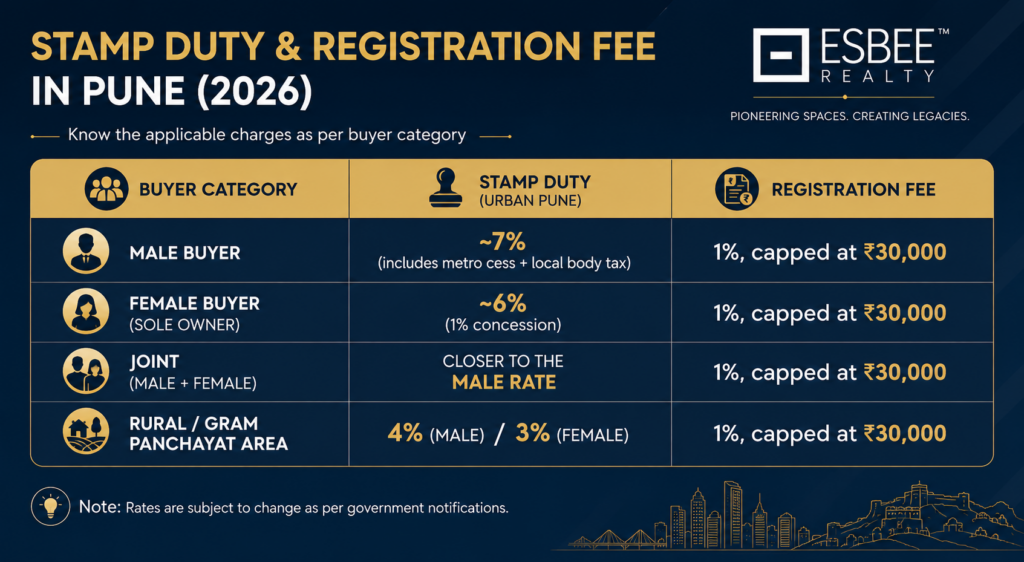
Duty is calculated on whichever is higher — your agreement value or the government’s Ready Reckoner Rate for that area. Many families register solely in the woman’s name to claim the concession, which can save over ₹50,000 on a ₹1 crore home.
Payment is made online via the IGR Maharashtra GRAS portal, after which both parties visit the Sub-Registrar’s office with documents and witnesses to execute and register the sale deed.
Common mistakes to avoid at this stage: forgetting to include the metro cess in your calculation, delaying registration beyond four months after paying stamp duty (which can require repayment), and relying only on the agreed sale price instead of checking it against the Ready Reckoner Rate.
Step 14: Complete Post-Registration Formalities
Registration isn’t the finish line. After it:
- File for mutation with PMC/PCMC or the relevant local body to update property tax records in your name — frequently skipped, but essential
- Apply for society membership and get the share certificate transferred (for apartments)
- Transfer or apply fresh for utility connections electricity, water, gas, property tax account
- Keep certified copies of the registered sale deed, Index II, and all payment receipts — you’ll need these for any future resale, loan, or legal matter
Step 15: Final Inspection and Possession
For ready property, do a physical inspection before taking possession: check for construction defects, confirm all promised fittings and amenities are in place, and get the demand letter and completion documents. For under-construction property, confirm the OC has been issued before making the final payment don’t hand over the last installment until documentation is in order.
See Why Buy a Home in Pune Is the Right Choice for Every Homebuyer –
FAQ –
Start by clarifying your purpose for buying self-use, investment, or rental income and setting a complete budget that includes stamp duty, registration, and maintenance costs, not just the property price.
Stamp duty in Pune is typically around 7% of the property’s value for male buyers and 6% for female buyers (sole ownership), calculated on the higher of the agreement value or the government’s Ready Reckoner Rate. Registration fees are 1%, capped at ₹30,000.
Check the project’s RERA registration number directly on the MahaRERA portal (maharera.mahaonline.gov.in), which also shows the promised completion date and any registered complaints against the developer.
At minimum: RERA registration, the title deed/ownership chain, Encumbrance Certificate, Occupancy Certificate (for ready property), the approved building plan, and confirmation there are no outstanding dues on the property.
You still need to complete mutation (updating municipal property tax records in your name), transfer or apply for utility connections, and get society membership/share certificate transferred — these are often overlooked but are necessary for the property to be fully and legally yours in practice.